Lady Buddha - I need your help!
- Liz

- Jan 14, 2025
- 7 min read
Updated: Apr 19, 2025
Da Nang, Day 53
Oh no, disaster has struck one of the mighty Twogotravelling duo! This time, it is R who must have been licking windows, as he has a sore throat and a cough. I guess that perhaps explains why he thought the tea from yesterday had a 'metallic' taste to it, and why it seemed fine with me.
So, what is the plan for today? Well, as we have already covered a fair bit of Da Nang on foot, we thought we might visit Lady Buddha (and let's face it - I now need her assistance more than ever with R being 'no well'!).
So after breakfast, we get a Grab taxi to take us up to Lady Buddha, which is about a 15-minute ride (8.5km) along the beach and up the hill from our hotel. The taxi ride costs £3.65, so it's pretty cheap. Another thing we have noticed in Vietnam compared to Thailand is that the taxi drivers do not seem to wear facemasks and it is most notable when they are coughing their lungs up and have the cab air recirculation button switched on (as was the case with the taxi driver from the airport and the one taking us up to Lady Buddha!). So R reckons he picked his 'sore throat bug' from the airport taxi ride.
But anyway, a few paracetamol and we're on our way to see this famous lady who sits on the mountainside and watches over Da Nang.
Goddess of Mercy - Lady Buddha
Sitting on a hilltop by the sea, Lady Buddha is a 67-meter-tall statue in Linh Ung Pagoda, Son Tra Peninsula. It’s known as Tuong Phat Ba Quan Am in Vietnamese, or Statue of the Goddess of Mercy. Thanks to its height, this work became the tallest of its kind in the country. Not only is Lady Buddha a statue, Lady Buddha is also a temple, because each of her 17 floors houses twenty-seven Buddha statues for worship. A 2-meter Great Buddha statue is placed at the head. Local people call “Buddha in Buddha” to describe the characteristic. On the first and 15th days of every lunar month, locals come here to pray and seek peace of mind.



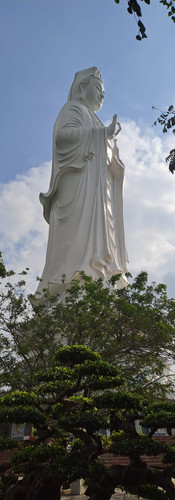

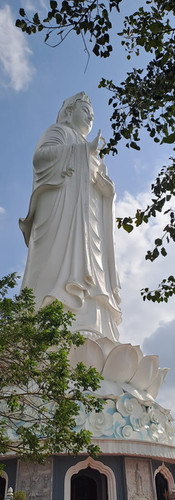


Lady Buddha is the Goddess of Mercy who is believed to see, hear and sympathise cries of people in the world. Her right hand holds a water vase, containing nectar of life and a willow branch in her left hand, used to sprinkle the nectar on the prayers. For fishers, she is also a patron saint who follows, gives fortune and saves them on the sea. That’s why they come to pray before setting sail. Standing on a blooming lotus, this perfect depiction faces the city, aiming to shelter its citizens from disasters. Locals have been believing that since her presence, typhoons don’t hit their hometown. In a wider view, as a part of the third Linh Ung Pagoda, itself and two other temples in Ba Na Hills and Marble Mountains create a triangle. Once again, that “fences” are bad things to locals.
The statue is very impressive and whilst we did not go inside (I'm not sure if you can go up the floors) but we are more interested in just observing and looking around at ground level.
The place was busy with tour buses and visitors, but it's a big place and it does not cost anything to visit. There is enough space, gardens and interesting statues to make you feel like you are there on your own.
I really enjoyed our time here as it was very serene and along with some gentle music and the views of the hills, the East Vietnam sea and the coastline, it was sort of magical.
Monkey Business
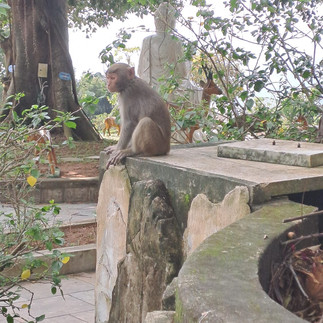
Even watching the many cheeky monkeys was fun. Monkeys are also abundant in this area, so visitors are advised not to bring food as they will try to snatch food and personal items from them if they get a chance, and not to touch the monkeys. We went to one area to take some photos, and before we knew it, there were loads of monkeys all about just doing their own thing. The baby monkeys were so cute, and watching them playing with each other whilst mum and dad groomed each other and watched 'the weans' from a distance just showed how similar monkeys are to the human family.



We probably spent about 1.5 to 2 hours here - just walking about, taking photos and enjoying the views. Then it was time to leave.

I was of the mind that we could just walk back to the hotel (1.5hr walk) as the route was pretty much all downhill and apart from the windy hill road bit, the rest was just a walk along the beach front. However, R was not keen on the windy road, so we compromised and got a taxi down the hill (which I will admit was the better idea as the squiggly bit of the hill was a little dodgy with its bends and traffic). That said, we did see some folks (tourists) walking down the hill as we drove past. This allowed us to visit another temple we had seen, and then we could walk along this section of the beach back to the hotel.

Buu Dai Son - Buddhist Temple
As we were coming down the hill in the taxi, the taxi driver used a translation app to tell us that the temple was closed but we had heard that this was a common scam type thing that is often said in tourist places, so that the taxi driver will suggest another place to take you to. Anyway, we weren't that bothered if it was closed or not, as we were really just planning to take some photos and walk back along the beach. So we confirmed that it was fine and we were ok with this, and we got dropped off outside the temple (taxi ride back down the hill to here was £2.51).
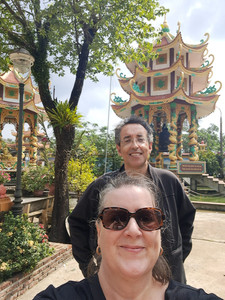
Then, lo and behold, we find the temple is actually open (as we suspected it would be), and we went into the compound. There was no one else about, and we were able to wander all around it and take photos. As usual, we didn't go inside any of the temple parts but just observed these areas from the outside stairs.
The temples again were pretty amazing and very ornate. The amount of work and effort that goes into these designs is just mind blowing. The colourful tiled dragons also appear to have spouts for water to come out of them, so I guess this is sort of similar to the Dragon Bridge which has water spouts for its impressive light and water shows.
Chua Buu Dai Son is perhaps the most spiritual and cultural site in the bustling city. This ancient pagoda is situated in the peaceful Son Tra Peninsula. Many tourists visit the pagoda every year to gain peace and spiritual enlightenment.
It is a historically relevant pagoda that dates back some centuries ago. The pagoda was created in the early 19th century by a group of Buddhists. This group had a vision of creating a sanctuary for worship and meditating on religious practices. The place soon became a strong cultural and spiritual core for the local communities.
The cultural significance of Chua Buu Dai Son cannot be overstated. The place has been central in the spiritual lives of Danang city residents as a praying venue due to their need for continuous prayer, meditation, and community connection. It has therefore been used for educational and charity work—a further sating effect in the community.
It has undergone several renovations and extensions in the past. This has been because of the growing needs of the congregants and the larger community. However, the renovations have not been a reason for destroying the hornbill’s historical nature and spiritual qualities.
There have been key events marking the temple’s journey. It became popular in the late 20th century, when the beloved monk Thich Nhat Hanh moved into the temple for a while. After that, the historical place came into sharp focus. In the early 2000s, the temple underwent preservation as people from around the world contributed money for the restoration project.







After we visit the temple area, we start the walk back to the hotel, and I was ever so glad we hadn't walked the whole way from Lady Buddha as the walk from the temple felt a lot longer than we had anticipated (even though it was only an hour's flat walk). Perhaps it was because we had been walking around before this, or maybe it was because there was not that much of interest to see along the way, that it felt longer. We had planned to maybe stop off for a drink or lunch, but we did not find a great selection of places or places that we were keen on eating at, so we just continued. We also stopped off and picked up some Listerine for his nibs as he was feeling a bit knackered with his 'bug' and we decided to just get a couple of Bahn mi's for a take away lunch back in our hotel room, and that way R could have a bit of a lie down and rest.
Dinner
Later on in the evening, we headed out to a nearby restaurant (Nhà Bếp Xưa Restaurant) that gets good reviews. R is still felling a bit rubbish but his appetite is still going strong!
We had a fabulous meal here, and the total cost was just over £10, which is just nuts!

After dinner, we go for a little walk, and before you know it, we are about to walk into a rain storm, and it's really odd as the rain seems to be falling from the sky, but we are dry on the bit of road we have been walking on. Anyway, we notice other people are on the street looking at the same phenomenon and wondering what is going on when someone says that they think there has been a problem with the rooftop swimming pool in one of the hotels. A lot of the hotels have these glass infinity-type pools, so perhaps some sort of failure had occurred. It was dark and difficult to see, so we just turned about and headed back to our hotel as we needed to start packing for our next move tomorrow when we leave the lovely Da Nang....
Oh I also should add that we were originally planning to go and see the Dragon Bridge show this evening (the bridge has a fire and water display every Saturday and Sunday at 9pm), but as R was not feeling great, the bridge is a bit of a walk away to get to and it only lasts 10 minutes, we decided to give it a miss. However, you can get an idea of what it's like from YouTube.
Also, there are some other tours and places that you can visit from Da Nang, but as the weather was not that clear and because R is afraid of heights, we gave them a miss, but they are also quite popular from this area:
Da Nang, Vietnam
11 January 2025


Comments