Halong Bay - Day 2
- Liz

- Jan 25, 2025
- 8 min read
Updated: Apr 19, 2025
Halong Bay, Day 62
Setting the alarm clock? Aren't we supposed to be retired? Yes, dear readers, we have had to set our alarm clock yet again as the cruise schedule is very tight and precise.
I also realise that I have not really given any information about Halong Bay itself, so let me rectify this right now before we go any further.
Hạ Long Bay or Halong Bay is a UNESCO World Heritage Site and a popular travel destination in Quảng Ninh province, Vietnam. The name Hạ Long means "descending dragon". The bay features thousands of limestone karsts and islets in various shapes and sizes.

Hạ Long Bay has an area of around 600 square miles, including 1,969 islets, most of which are limestone. The core of the bay has an area of 129 sq miles with a high density of 775 islets.
The limestone in this bay has gone through 500 million years of formation in different conditions and environments.

The evolution of the karst in this bay has taken 20 million years under the impact of the tropical wet climate. The geo-diversity of the environment in the area has created biodiversity, including a tropical evergreen biosystem and a seashore biosystem. Hạ Long Bay is home to 14 endemic floral species and 60 endemic faunal species.


The name Hạ Long means "descending dragon". According to local legend, when Vietnam had just started to develop into a country, it had to fight against invaders. To assist the Vietnamese in defending their country, the gods sent a family of dragons as protectors. This family of dragons began spitting out jewels and jade. These jewels turned into the islands and islets dotting the bay, linking together to form a great wall against the invaders. Under magics, numerous rocky mountains abruptly appeared on the sea, ahead of the invaders' ships; the forward ships struck the rocks and each other. After winning the battle, the dragons were interested in peaceful sightseeing of the Earth, and then decided to live in this bay.
Strangely enough seeing this amazing place and reading about this legend made me think of Cressida Cowell and her 'How to train your dragon' books....I can easily see how one's imagination would be sparked in such a spectacular environment.
The bay consists of a dense cluster of some 1,969 limestone monolithic islands each topped with thick jungle vegetation, rising spectacularly from the ocean. Several of the islands are hollow, with enormous caves. There are two bigger islands, Tuần Châu and Cát Bà, that have permanent inhabitants, as well as tourist facilities including hotels and beaches. There are a number of beautiful beaches on the smaller islands.

A community of around 1,600 people live on Hạ Long Bay in four fishing villages: Cua Van, Ba Hang, Cong Tau and Vong Vieng in Hung Thang ward, Hạ Long city.
Of the 1,969 islands in Hạ Long, only approximately 40 are inhabited. These islands range from tens to thousands of hectares in size, mainly in the East and Southeast of Hạ Long Bay. In recent decades, thousands of villagers have been starting to settle down on the pristine islands and build new communities.
Day 2
As mentioned previously, we sadly didn't make any of the Tai Chi sessions - oops, a daisy! However, we did manage to watch a stunning sunrise from our balcony before the fabulous buffet breakfast at 6.30 am. I have taken so many photos during our time in Halong Bay that it is quite difficult to decide which ones to use here, and I know they won't do it the justice it deserves, but I think you will get a sense of it.

During the breakfast the boat was on the move, so again it was just beautiful watching the scenery as the day was beginning.

Transfer to a Day Boat for the Cat Ba Island Tour
After breakfast, we had a short time until we were called to board the day boat which would take us to the Cat Ba island for a tour of a village there. The guide explained something about the different provinces that the islands come under and that has something to do with which boats are allowed to go where, as well as the paperwork and costs involved.
Regardless, we had a very relaxing time onboard the day boat, just watching the scenery and hoping that the early morning mist would clear up. The temperature was quite cool at this stage, but there were blankets for those who wanted to stay on the outer deck areas, and there were also inside areas. It was also possible to order drinks, but we had only just had breakfast, so we were fine. The boat took about 1.5 hours, I think, until we arrived at the bay, and we were then able to board another transfer boat to take us to the island.


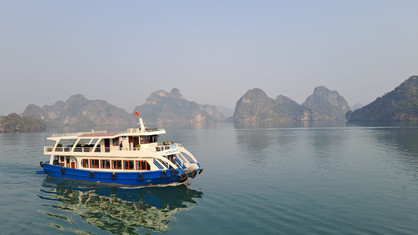


Cát Bà Island is the largest of the 367 islands spanning 101.32 square miles that comprise the Cat Ba Archipelago, which makes up the southeastern edge of Lan Ha Bay in Northern Vietnam and maintains the dramatic and rugged features of Ha Long Bay. The archipelago has been a UNESCO Biosphere Reserve since 2004 and a part of the Ha Long Bay - Cat Ba Archipelago World Heritage Site since 2023.
Cat Ba (historically called Cac Ba) Island means "Women’s Island" (Cac meaning 'all' and 'Ba' meaning women). Legend has it that many centuries ago, three women of the Tran Dynasty were killed and their bodies floated all the way to Cat Ba Island. Each body washed up on a different beach, and all three were found by local fishermen. The residents of Cat Ba built a temple for each woman, and the island soon became known as Cat Ba.
Archaeological evidence suggests that people have lived on Cat Ba Island for almost 6,000 years, with the earliest settlements being found on the southeastern tip of the Island close to the area where Ben Beo harbour sits today.
In more recent history, Cat Ba Island was inhabited mostly by Vietnamese-Chinese fishermen and was largely influenced by both the French and American wars. The island was a strategic look-out point and bombing during the wars often forced local residents to hide among the Island's many caves.
In 1979, the third Indo-China War broke out between China and Vietnam in response to Vietnam's invasion of Cambodia that ended the reign of the Khmer Rouge. Relations between China and Vietnam collapsed, leading to the Vietnamese government evicting around 30,000 fishermen and most of the rest of the Chinese community from the greater Ha Long area.
The development of infrastructure on Cat Ba in the 1990s greatly improved the island's accessibility. These developments include: the construction of bigger roads; the construction of dams to build harbours and to protect Cat Ba town from flooding; consistent electricity being brought to the island in 1997; and the introduction of daily scheduled large ferries and barges, able to transport trucks and cars from the mainland. These developments led to a rapid increase in tourism and development in Cat Ba town starting in 2001. Since then, a stop on Cat Ba Island has been included in the itinerary of many Ha Long Bay cruises, and a strip of tall, thin, five-storey budget hotels lines the seafront. Cat Ba Island receives over 350,000 visitors a year.
Cat Ba Island has become the adventure-tourism capital of Vietnam, and many of the activities advertised are nature-based. With its scenery, its association with Ha Long Bay, its proximity to cities like Haiphong (50 km) and Hanoi (150 km), and even China, Cat Ba Island has become a major travel destination for foreign and Vietnamese visitors alike.
Viet Hai Village, Cat Ba Island
Located approximately 18 km from Cat Ba Island, the small fishing village named Viet Hai is amid jungles, covered by high mountains. The village is situated in the heart of Cat Ba National Park, which belongs to the Cat Hai Island District of Hai Phong City.
To get to the village, you have two options: ride a bike or take the electric cart - as R never learnt to ride a bike (& it's been many years since I was last on a bike!), we elected for the electric buggy.


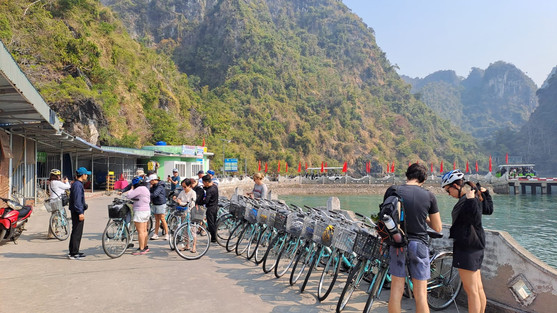


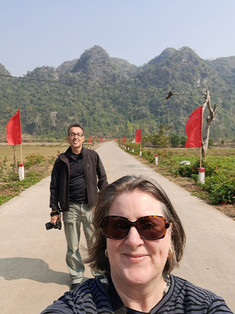



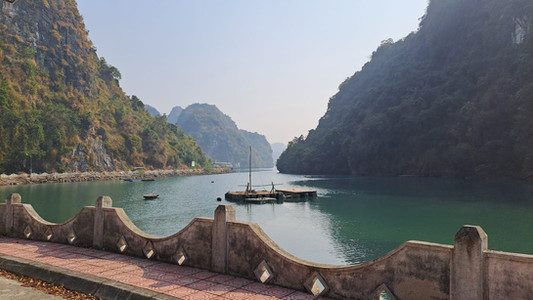
Once we reached the village, our tour guide gave us an explanation of life there, how it has evolved and changed over the years, and we we able to try some rice wine and buy some souvenir items from the locals. It was very impressive to see how sustainable these people have become, and we saw how they grow their own crops (apart from rice, as they can no longer grow this, so they have to buy it in from the mainland). After a short time here, it was time to make the return journey back to the transfer boat and the day boat, where our lunch would be served.
Lunch on the Day Boat
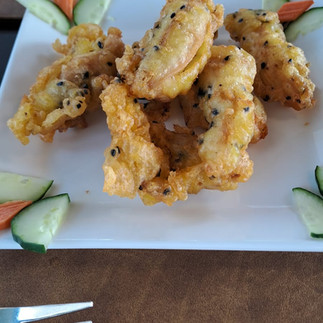
We had Harry serving on the Day Boat and again, the meal was absolutely superb...but also a lot more than we would normally have for a lunch.




Kayaking
After lunch, it was time for swimming and kayaking again. We were in a different location this time, and we had beaches, arches and land that we could kayak to, so we set sail with R in the front this time and me at the rear. We fared much better on this occasion (or perhaps we were faster at adapting to the direction of travel this time!), but we had a blast in the water and on the nearby beaches. I like to think of it as us working off our lunch, too!






After our time was up in the bay, we returned to the Day Boat and it travelled back to the main 'big' boat where we were greeted with hot ginger tea on arrival (this was delicious and I guess it is incase anyone is prone to motion sickness).
Once we had showered and changed, we sat out in the balcony and this time we didn't bother with the Happy Hour in the bar and lounge area.

Instead we had brought (another Top Tip for you!) a cheeky bottle of red wine with us (bought from a supermarket in Hanoi, at a fraction of the price of wine on the boat and very carefully wrapped in a drysack within my rucksack to ensure it survived in one piece!).
So we sat and enjoyed our wine, putting the world to rights as we watched the sunset from our balcony for one last evening.


Oh I should also add here that for the Happy Hour, the deck plays 'party tunes' and as R is getting to that grumpy old man stage, so he didn't appreciate these 'tunes' in this environment and setting (he did have a point) as it would have been more fitting if they played music that was more 'in tune' with the surroundings (yes, yes I know we are showing our old age but you had to be there to see and hear what we mean). That said, I did tell him it could have been worse and they could have had karaoke going on instead - now that probably would have sent him overboard. Anyway, that quietened him down for a while.
Evening Dinner
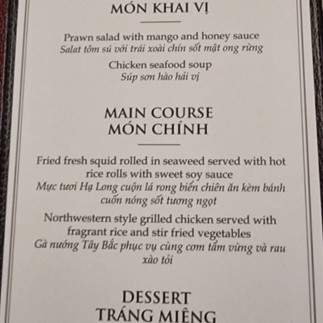
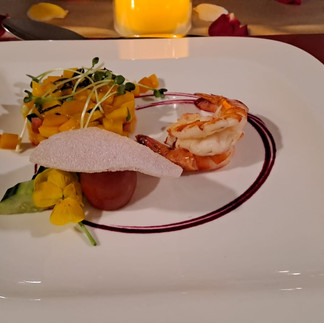
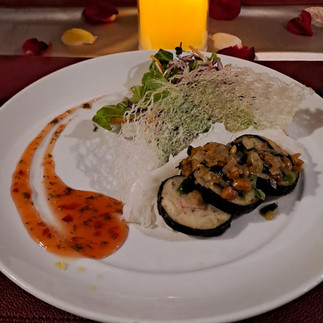
This was another mammoth undertaking but we had learnt our lesson and as we didn't go to the Happy Hour, we didn't eat any of the snacks and neither did we attend the 2nd cookery demonstration (for a different type of spring roll), so we were a bit more prepared this time around. It was all absolutely amazing and delicious. R didn't have the squid course, but I did and they were awesome.






After dinner, we retired to our balcony once again to watch the other boats in the bay and the stars in the sky. I had a lovely cup of coffee whilst R had a coke. It was total bliss...and then we started to pack our things as much as possible as we were leaving the following morning....

Halong Bay, Vietnam
20 January 2025


Comments